
Declaration of Independence… Essay # 9: “Laying its Foundation on Such Principles”
I begin this essay continuing the discussion regarding the power and influence of “love” where I left off in the prologue of the previous essay.
The following is an excerpt from a recent speech by Illinois Governor J.B. Pritzker which I found striking especially coming from a politician:
“I’ve been thinking a lot lately about love —about loving people and loving your country and the power involved in both,” the governor said. “I know, right now, there are a lot of people out there who love their country and feel like their country is not loving them back. I know that.” But he told those people that “your country is loving you back—just not in the way you are used to hearing.”
“It’s not speaking in anthems or flags or ostentatious displays of patriotism. It will never come from the people who say the only way to love America is to hate Americans. Love is found in every act of courage—large and small—taken to preserve the country we once knew. You will find it in homes and schools and churches and art. It is there; it has not been squashed.”
Pritzker called out the love shown by “the bicyclers who showed up in Little Village every day during Operation Midway Blitz to buy out tamale carts so the vendors could return to the safety of their homes,” “the parishioners who formed human chains around churches so that immigrants could worship,” and “the moms in the school pickup line who whipped out their cameras and their whistles,” and in “the face of every Midwesterner who put on their heaviest coat and protested outside on the coldest day.”
That love for one’s neighbor, he suggested, is the country’s most powerful tool against the rise of authoritarianism.
“I am begging my fellow politicians, my fellow Illinoisans, my fellow Americans to realize that right now in this country we are not fighting over policy or political party,” Pritzker said. “We are fighting over whether we are going to be a civilization rooted in empathy and kindness—or one rooted in cruelty and rage.”
“I love my country,” Pritzker said. “I refuse to stop. The hope I have found in a very difficult year is that love is the light that gets you through a long night.”
Another politician, James Talarico, the Texas senatorial candidate, has been known for his strong faith and his advocacy for public education. He often quotes “Love thy Neighbor” as a slogan to rally his supporters and emphasize the importance of community and mutual respect like the Illinois governor. Talarico has said “every single person bears the image of the sacred; every single person is holy — not just the neighbors who look like me or pray like me or vote like me.”
He has also said “The billionaires want to keep us from seeing all that we have in common. They want to keep us from realizing there’s far more that unites us than divides us.” These quotes reflect Talarico’s commitment to love and community, which he believes are essential for building a strong and united Texas as well as the United States as a whole.
We can only hope! It would be wonderful if we could we start all discussions within the spirit of love which I will continue to do in the prologues of the remaining four essays in this series.
Two final and repeated notes: there will be some repetition from previous essays and this one amplifies both the discussions in Essay #5 and #8. I hope readers will continue to see that more as reinforcement versus annoyance. Secondly, a continued shout out to my resource partner, CHAT GPT, for its contributions with each of these essays.
I. Introduction: A Revolutionary Blueprint
The Declaration of Independence proclaims:
“…it is the Right of the People to alter or to abolish it, and to institute new Government, laying its foundation on such principles and organizing its powers in such form, as to them shall seem most likely to affect their Safety and Happiness.”
This phrase is not just about tearing down tyranny. It is about building something better.
Revolution is not destruction for its own sake. It is the act of replacing illegitimate power with legitimate governance rooted in principles that secure human rights.
The Founders offered a theory of democratic renewal:
When government fails, people have the right to abolish it.
But that right carries responsibility: to lay a new foundation on principles that promote safety, happiness, and liberty.
This idea shaped the American Revolution.
But the promise of building government on just principles has remained contested and incomplete.
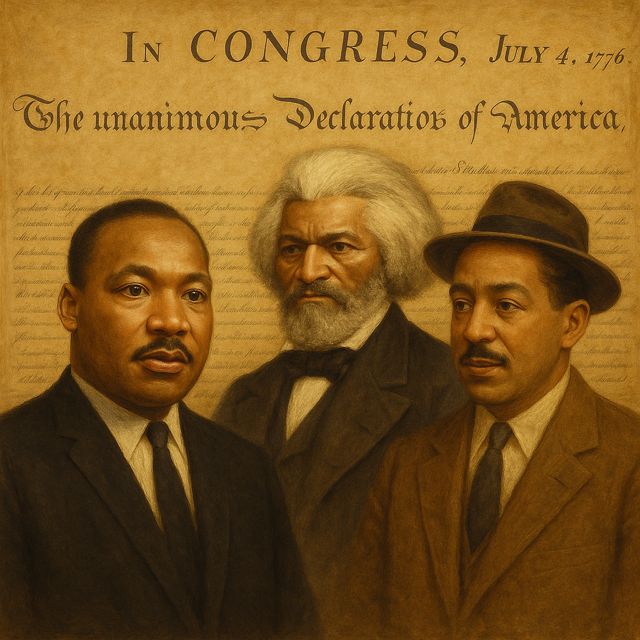
From Frederick Douglass to Martin Luther King Jr. to Langston Hughes, generations of critics have asked:
- What principles should guide the nation?
- Who gets to help lay the foundation?
- How do we ensure those principles are real, not rhetoric?
Their words challenge us to see that “laying its foundation on such principles” is not a one-time event but an ongoing project of democracy.
II. The Declaration’s Radical Claim
When the Declaration asserts the right to institute new government on just principles, it rejects the idea of unchangeable hierarchy. It denies:
- The divine right of kings
- Aristocratic privilege
- Permanent colonial subordination
Instead, it insists that all political systems must be built on principles chosen by the people themselves.
This is not moral relativism. The Declaration insists on universal truths:
- That all are created equal
- That rights are unalienable
- That government must secure these rights
“Laying its foundation on such principles” means founding political institutions on justice, not brute force.
It is a blueprint for revolution—but also for constitutionalism.
III. The Founding Achievement—and Contradiction
The American Founders sought to embody this principle by creating written constitutions.
After independence, the former colonies drafted new state constitutions that:
- Defined government powers
- Included declarations of rights
- Established representative legislatures
The U.S. Constitution itself was an attempt to lay a foundation on agreed-upon principles.
It was a remarkable achievement:
- Separation of powers
- Checks and balances
- Amendment procedures
- The Bill of Rights
But it was also compromised from the start:
- Slavery was protected
- Native sovereignty was ignored
- Women were denied political voice
- Property and wealth shaped participation
The Constitution laid a foundation—but on principles that selectively applied equality and rights.
IV. Frederick Douglass: Critic and Defender of the Constitution
Frederick Douglass wrestled with this contradiction throughout his life.
In his early speeches, he condemned the Constitution as “a covenant with death” because it protected slavery.
But he later argued it was a glorious liberty document that could be interpreted as an anti-slavery text.
He believed the principles of the Declaration were universal and could be used to reform the Constitution.
In his 1852 speech “What to the Slave Is the Fourth of July?” Douglass said:
“I have said that the Declaration of Independence is the ring-bolt to the chain of your nation’s destiny; so, indeed, I regard it. The principles contained in that instrument are saving principles.”
For Douglass, laying a foundation on just principles required abolishing slavery and guaranteeing rights to Black Americans.
He insisted the nation could not call itself free while denying liberty to millions.
V. Abolition as Foundational Change
The abolition of slavery was not just a legal reform. It was a revolutionary refounding of American government.
The 13th Amendment abolished slavery.
The 14th Amendment guaranteed equal protection.
The 15th Amendment secured voting rights for Black men.
These amendments redefined the foundation of American citizenship and rights.
Frederick Douglass saw them as the fulfillment of the Declaration’s promise:
“We stand today at the national altar where we must swear anew to be true to the principles of liberty and equality.”
Yet even in this triumph, the foundation was unstable.
Reconstruction’s overthrow through violence and Jim Crow laws revealed that formal constitutional change was not enough if powerholders refused to honor those principles.
VI. The Betrayal of Reconstruction: A Broken Foundation
After federal troops withdrew from the South in 1877, white supremacists rebuilt state governments on racist foundations:
- Disenfranchising Black voters
- Segregating schools and public spaces
- Enforcing sharecropping and convict leasing
- Using terror to silence dissent
They replaced the promise of equal protection with an architecture of racial domination.
Douglass warned that the foundation of the nation would remain illegitimate if it rested on white supremacy.
He argued that laying a just foundation required:
- Protecting Black voting rights
- Guaranteeing safety from racial violence
- Building equitable economic opportunity
Douglass understood that without these principles, the nation would betray its highest ideals.
VII. Martin Luther King Jr.: A Renewed Call for Foundational Principles
Nearly a century after Douglass, Martin Luther King Jr. took up the same demand for America to lay its foundation on genuine principles of justice and equality.
King did not reject the American ideal outright. He demanded its realization.
In his 1963 “I Have a Dream” speech, he framed the movement as a call for America to honor a promissory note:
“When the architects of our republic wrote the magnificent words of the Constitution and the Declaration of Independence, they were signing a promissory note to which every American was to fall heir.”
King charged America with defaulting on this note for Black citizens.
He insisted that the civil rights movement was not asking for anything radical beyond honoring the principles that supposedly founded the nation.
He said “This is no time to engage in the luxury of cooling off or to take the tranquilizing drug of gradualism.”
King understood that genuine change required more than small adjustments. It required a new moral foundation rooted in equality and justice.
VIII. The Civil Rights Act and Voting Rights Act: Laying New Foundations
The Civil Rights Movement achieved landmark legislation that sought to repair the broken foundation:
- The Civil Rights Act of 1964 outlawed segregation in public spaces and employment discrimination.
- The Voting Rights Act of 1965 attacked the tools of disenfranchisement.
These laws attempted to enforce the 14th and 15th Amendments, realizing long-denied promises.
King celebrated these victories but warned they were insufficient on their own.
He insisted that laws were only tools—and that the deeper work was building a society that truly respected human dignity.
He called for economic justice, saying:
“True compassion is more than flinging a coin to a beggar; it understands that an edifice which produces beggars needs restructuring.”
For King, laying the foundation on just principles meant transforming social and economic systems—not merely ending overt segregation.
IX. The Poor People’s Campaign: Expanding the Principles
In 1968, King launched the Poor People’s Campaign as an effort to redefine the foundation of American society.
He argued that the United States must guarantee:
- Decent housing
- Good jobs
- Living wages
- Quality education
- Healthcare
He saw these not as charity but as rights owed by a society that claimed to secure the people’s “safety and happiness.”
King’s vision was expansive:
It included poor Black communities, but also poor white, Latino, and Native communities.
It recognized that racism and economic injustice were interlinked.
He warned: “America is at a crossroads of history, and it is critically important for us as a nation and a society to choose a new path and move upon it with resolution and courage.”
King understood that laying the foundation on just principles required rethinking American priorities.
X. Nonviolence as a Foundational Principle
King also argued that the method of change must embody the principles it sought to establish.
He insisted on nonviolence not as passive submission but as active moral resistance.
He saw nonviolence as:
- A way to honor the dignity of opponents
- A strategy to win allies among the broader public
- A means to avoid replicating the violence one opposes
King declared:
“We must pursue peaceful ends through peaceful means.”
He believed the foundation of a just society could not be laid through hatred or vengeance.
Nonviolence was itself a foundational principle—a commitment to justice, love, and community.
XI. Langston Hughes: The Dream of a New Foundation
Langston Hughes, too, demanded that America lay its foundation on real, inclusive principles.
His poem “Let America Be America Again” begins with a critique:
“America never was America to me.”
But Hughes does not reject America outright. He calls for its transformation:
“O, yes,
I say it plain,
America never was America to me,
And yet I swear this oath—
America will be!”
Hughes insisted that the American ideal was beautiful—but only if made real for all.
He gave voice to those left out of the foundation:
- The Black worker
- The immigrant
- The Indigenous person
- The poor white farmer
Hughes’s revolutionary demand was for a foundation broad enough to include everyone.
XII. Exposing Hypocrisy: The Principles vs. Practice
Hughes was unsparing about the gap between America’s proclaimed principles and its actual foundation:
“The land that never has been yet—
And yet must be—the land where every man is free.”
This was not cynicism. It was realism.
Hughes understood that lofty principles mean nothing if institutions contradict them.
He used poetry to reveal:
- Racial exploitation
- Economic injustice
- Broken promises
He called Americans to recognize this hypocrisy as a first step toward true change.
By refusing to accept a false foundation, Hughes insisted on the moral obligation to build a better one.
XIII. Structural Racism: A Flawed Foundation
Both King and Hughes understood that racism was not simply a set of individual prejudices.
It was structural—built into laws, institutions, and economic systems.
Jim Crow was not an accident. It was a deliberate architecture of inequality:
- Segregated schools
- Voting restrictions
- Housing discrimination
- Employment exclusion
King called for the desegregation of American life not just physically, but economically and spiritually.
He argued that dismantling these structures was part of laying a new foundation on the principle of equality.
XIV. Economic Justice: Expanding Foundational Principles
Martin Luther King Jr. recognized that a society’s foundation is not only legal or political—it is economic.
He argued that true freedom required economic security:
“What good is having the right to sit at a lunch counter if you can’t afford to buy a hamburger?”
In his final years, King expanded the civil rights struggle into a human rights struggle that included:
- Living wages
- Full employment
- Affordable housing
- Access to healthcare
He saw poverty as a form of violence that destroyed dignity and opportunity.
For King, a society built on just principles would not tolerate extremes of wealth and poverty.
He called for a revolution of values, saying:
“We must rapidly begin the shift from a ‘thing-oriented’ society to a ‘person-oriented’ society.”
This was not merely reform. It was a new foundation for society rooted in justice, compassion, and human dignity.
XV. The Challenge of Building New Foundations
Changing laws is only part of laying a new foundation.
- Systems must be reimagined
- Power must be redistributed
- Culture must change
- Hearts and minds must be transformed
King understood that racism, poverty, and militarism were interlocking evils.
He argued that ending one required addressing them all.
He insisted that nonviolence, democracy, and solidarity were the essential building blocks of a just society.
Hughes, in his poetry, captured the struggle of the marginalized to claim a place in this foundation.
“I am the poor white, fooled and pushed apart,
I am the Negro bearing slavery’s scars.”
Hughes refused to let anyone be forgotten in the new design of America.
XVI. The Necessity of Inclusion
The Declaration says the people have the right to create government “as to them shall seem most likely to effect their Safety and Happiness.”
Who is “them”?
Historically, the answer excluded:
- Enslaved Africans
- Indigenous nations
- Women
- Immigrants
- The poor
Frederick Douglass asked America to expand “We the People” to include Black Americans.
King demanded that democracy be genuine—giving voice and power to all citizens.
Hughes insisted that America could only be America if it embraced its diversity and complexity.
Laying a new foundation requires universal inclusion:
- Voting rights for all
- Equal protection under law
- Economic opportunity for all
- Recognition of cultural and human dignity for all
XVII. Democracy as a Foundational Principle
A true foundation rests on consent of the governed.
But consent is meaningful only if it is informed, inclusive, and effective.
Gerrymandering undermines consent.
Voter suppression denies it.
Concentrated wealth distorts it.
Frederick Douglass warned that freedom without the ballot was hollow.
King argued that democracy meant more than elections; it meant participatory decision-making in all areas of life, including the economy.
For both, democracy was not simply a form of government but a moral principle of shared power.
XVIII. The Role of Memory and History
Laying a new foundation also requires an honest reckoning with the past.
America’s founding principles were proclaimed in 1776—but denied in practice to millions.
Genocide of Native peoples.
Enslavement of Africans.
Exclusion of women.
Exploitation of immigrants.
King called on America to confront these truths without denial or evasion:
“We must make the pledge that we shall always march ahead. We cannot turn back.”
Hughes’s poetry refuses to forget the people America tried to erase:
“I am the man who never got ahead,
The poorest worker bartered through the years.”
Acknowledging history is not about guilt—it is about understanding the work that remains.
XIX. Building Institutions That Reflect Principles
Declaring principles is easy. Embodying them in institutions is hard.
Schools must teach critical thinking and civic responsibility.
Courts must uphold equal justice.
Police must protect, not oppress.
Economy must provide dignity and opportunity.
Media must inform, not manipulate.
Frederick Douglass insisted that power concedes nothing without demand.
King argued that unjust laws must be challenged.
Hughes asked us to imagine what America could be if it truly served everyone.
A new foundation means designing institutions to secure rights, promote equality, and foster democracy—not to entrench privilege.
XX. Conclusion: The Ongoing Work of Laying the Foundation
“…it is the Right of the People to alter or to abolish it, and to institute new Government, laying its foundation on such principles and organizing its powers in such form, as to them shall seem most likely to affect their Safety and Happiness.”
These words remain a challenge to every generation.
They remind us:
- Government is a tool to secure rights
- Legitimacy depends on just principles
- Change is not betrayal but fulfillment of our highest ideals
Frederick Douglass used them to demand the abolition of slavery.
Martin Luther King Jr. used them to demand civil rights, economic justice, and peace.
Langston Hughes used them to demand inclusion for all people America had excluded.
Their legacy calls us to:
- Examine our principles
- Confront our failures
- Build institutions that honor human dignity
- Expand democracy and justice
- Never settle for partial freedom
To lay the foundation on just principles is not a single moment in history.
It is the ongoing work of democracy.
It is the responsibility of each generation to build, critique, reform, and reimagine.
It is the promise of the Declaration, still waiting to be fulfilled!
