
Declaration of Independence … Essay #11: “Most Likely to Affect Their Safety and Happiness”
At the conclusion of my last essay, I stated “that government exists to secure the rights, dignity, and well-being of all the people. Until our institutions truly do that, our work is not done.’
Said another way, government’s moral purpose is for our safety & happiness, the topic of this essay. Its closing words bear repeating:
To honor the principle of safety & happiness is not to seek comfort, it is to pursue justice.
It is to recognize that no form of government is sacred unless it serves the people well.
It is to embrace the work of civic transformation as a patriotic duty.
Let this generation rise to the task:
To reimagine, reclaim, and reshape a government worthy of our deepest hopes— and most likely to affect our collective safety & happiness.
Now ask yourself, do you feel safe and happy with our federal government today? I believe the resounding response will be patently obvious with a resounding NO! Virtually every day there is no sense of governing, let alone safety & happiness, in the face of the ongoing, relentless chaos, cruelty, and corruption of the Trump regime, Congress, and the Supreme Court.
So where lies the hope? As many of you know, one of my sources of “despair avoidance” is from the words and writings of Fr. Richard Rohr. From his May 12th reflection, with some adaptations on my part, are his words of inspiration:
“A time of crisis and chaos …. is, among other things, a time to call on our ancestors (e.g. our Founding Fathers) for their deep wisdom. Not just knowledge but true wisdom is needed in a time of death and profound change, for at such times we are beckoned not simply to return to the immediate past, that which we remember fondly as “the normal,” but to reimagine a new future, a renewed humanity, a more just and therefore sustainable culture, and one even filled with joy.”
“(The Founding Fathers) not only speak to us today but to shout at us …. to wake up and to go deep, to face the darkness and to dig down and find goodness, joy and awe. And to go to work to defend Mother Earth and all her creatures, stripping ourselves of racism, sexism, nationalisms, anthropocentrism, sectarianism—anything that interferes with our greatness as human beings. And to connect anew to the sacredness of life.”
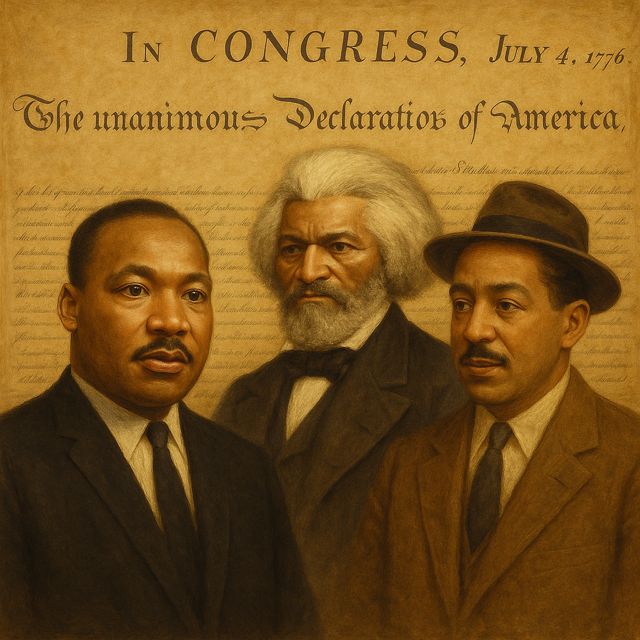
I’m not sure about you, but after reading this I exhaled a huge “wow” of hope! Two others of the Rohr “ilk” include Pope Leo and Bishop William Barber. I encourage you to seek ways to be inspired and seek solace through their leadership, insights, and writings in addition to the three icons speaking to us in this essay series.
One last quote I will leave you with before this month’s essay. It is from the book ‘Separation of Church and Hate’ by John Fugelsang, pg. 282:
“The struggle against hypocrisy and spiritual thuggery won’t be fought by politicians. It’ll be won by ordinary people (us), calmly proving that hate is NOT a Christian value — at their jobs, over the family dinner table, and on social media.
If you want to trigger and enrage Christian nationalists, Jesus will show the way. Stand up for the oppressed, welcome the stranger, love your enemy, fight poverty and injustice, resist violence, and choose compassion.”
Bottomline: PARTICIPATE and ENGAGE!
Two final and repeated notes: there will be some repetition from previous essays. I hope readers will continue to see that more as reinforcement versus annoyance. Secondly, a continued shout out to my resource partner, CHAT GPT, for its contributions with each of these essays.
I. Introduction: Government’s Moral Purpose
Embedded within the Declaration of Independence is a revolutionary and pragmatic idea:
Governments derive their legitimacy not from tradition, monarchy, or conquest, but from their ability to secure the “safety and happiness” of the people.
“…laying its foundation on such principles and organizing its powers in such form, as to them shall seem most likely to affect their Safety and Happiness.”
This phrase is more than poetic flourish—it is a radical assertion that political systems exist for the people, and that their form and structure must be evaluated not by historical precedent, but by the real, lived outcomes they produce.
It introduces an ethical test:
- Do our institutions protect the vulnerable?
- Do they promote well-being, dignity, opportunity, and peace?
- Do they ensure that all people—regardless of class, race, or status—are safe and free to pursue happiness?
The answer, as both Frederick Douglass and Martin Luther King Jr. forcefully argued, has too often been no.
And as Langston Hughes lamented, the promise of “America” has been deferred for generations.
This essay explores how these three American prophets challenge the nation’s failure to live up to this principle—and how they insist that the safety and happiness of the people, especially the marginalized, must become the measure of our laws, policies, and institutions.
II. The Radical Idea of “Happiness”
At first glance, “safety and happiness” may sound soft compared to “life, liberty, and the pursuit of happiness.”
But here, Jefferson was building a different kind of foundation.
He was saying that the form of government itself must be evaluated by whether it is effective in serving the well-being of the people.
This is not a theory of divine right, or rule by elites. It is a government by results—accountable not in rhetoric but in reality.
“Happiness” in the 18th-century Enlightenment context didn’t mean fleeting pleasure. It referred to flourishing—to the conditions in which people could lead meaningful, free, and prosperous lives.
In modern terms, this principle challenges us to ask:
- Are our schools enabling children to flourish?
- Are our laws protecting families from violence and exploitation?
- Are our economic policies lifting people out of poverty—or keeping them in it?
- Is our system of justice making people feel secure—or fearful?
The Declaration does not say which form of government must be used. It says the people may choose whichever form is most likely to affect their safety and happiness.
This opens the door to change—to adaptation—to progress.
And: it opens the door to revolution when government fails.
III. Douglass: When Government Becomes Destructive
Frederick Douglass understood better than most how hollow the promises of “safety and happiness” could be for those denied full citizenship.
In his July 5, 1852 speech, he asked with searing precision:
“What, to the American slave, is your Fourth of July?”
To enslaved people, the government was not a protector—it was a violator.
It did not secure safety or happiness; it ensured exploitation, violence, and legal bondage.
Douglass exposed the hypocrisy of a nation claiming liberty while protecting slavery with:
- The Fugitive Slave Act, which turned free states into hunting grounds
- The Constitutional compromise that counted enslaved people for representation, but gave them no vote
- The Supreme Court, which in Dred Scott v. Sandford denied Black people any claim to citizenship
Douglass argued that when a government becomes the instrument of oppression, it loses its moral legitimacy.
His critique rested squarely on the Declaration’s principle:
“…when a long train of abuses and usurpations…evinces a design to reduce them under absolute Despotism, it is their right, it is their duty, to throw off such Government.”
Douglass insisted that Black Americans had not yet received the “safety and happiness” that justified government at all.
He did not ask to be included in the nation as it was—he demanded that the nation transform itself into one worthy of inclusion.
IV. King: The Insecurity of Inequality
A century later, Martin Luther King Jr. revived the moral urgency of this Declaration principle.
In his 1963 “I Have a Dream” speech, King described the United States as having defaulted on a promissory note:
“Instead of honoring this sacred obligation, America has given the Negro people a bad check, a check which has come back marked ‘insufficient funds.’”
The safety and happiness that government was supposed to provide had not reached Black Americans:
- Southern states allowed terror and lynching
- Police enforced racial hierarchies
- Public funds built white schools and left Black schools crumbling
- Labor laws and zoning policies locked Black families in poverty
King’s work reframed civil rights as more than legal claims—they were demands for conditions that made life safe, dignified, and full of possibility.
King knew that true happiness requires freedom, and freedom requires justice—not merely the absence of physical danger, but the presence of opportunity and equality.
He called not for superficial reform, but for a revolution in values, in institutions, and in the moral commitments of the nation.
V. Hughes: The Dream That Has Never Been
Langston Hughes, in “Let America Be America Again,” gives voice to those who have never known the promise of safety or happiness under the American flag.
“I am the poor white, fooled and pushed apart,
I am the Negro bearing slavery’s scars.
I am the red man driven from the land,
I am the immigrant clutching the hope I seek—
And finding only the same old stupid plan
Of dog eat dog, of mighty crush the weak.”
Here, Hughes is mapping not a single injustice, but a systemic failure—a nation whose systems are designed to uplift some at the cost of others.
For Hughes, the form of American government has been wrong from the beginning—crafted not for universal happiness, but for the protection of wealth and whiteness.
And yet, he does not abandon the American ideal. Instead, he reclaims it:
“O, let America be America again—
The land that never has been yet—
And yet must be…”
Hughes calls us to redesign society—to change the form of power until it produces safety and happiness for all, not just a privileged few.
This vision is democratic, defiant, and full of hope.
VI. When Safety Becomes Selective
In the American tradition, “safety” has often been defined and enforced selectively, depending on whose interests the government is designed to protect.
For enslavers, “safety” once meant the ability to maintain property in human beings.
For segregationists, it meant defending the “social order” of white supremacy.
For wealthy industrialists, it meant quelling labor unrest to preserve profits.
But when safety is defined by the powerful to exclude the oppressed, it becomes a weapon rather than a right.
This is why Black Americans, Indigenous peoples, immigrants, and the poor have so often lived outside the boundaries of governmental protection. In many cases, government institutions have served not as guardians of safety but as agents of violence—through police brutality, environmental neglect, or economic abandonment.
As Dr. King put it, “There is no noise louder than the clamor for law and order when justice is absent.”
The Declaration of Independence does not call for order for its own sake; it calls for a government that actively fosters well-being, equity, and human dignity.
Government is not legitimate because it exists. It is legitimate only when it delivers.
VII. The Danger of Institutional Inertia
One of the greatest barriers to realizing the Declaration’s vision is institutional inertia—the tendency of systems to preserve their own power even when they fail the people they were created to serve. Consider:
- Education systems that chronically underfund schools in Black and brown neighborhoods
- Health care systems that deny care to the uninsured
- Housing policies that segregate cities and deepen wealth inequality
- Policing systems that claim to promote safety but breed fear in communities of color
When these systems resist change, despite overwhelming evidence of harm, they betray the principle that governments must be shaped to best effect the people’s safety and happiness.
Frederick Douglass faced this when the U.S. government refused to enforce civil rights protections after Reconstruction.
Dr. King faced it in the North as well as the South, encountering liberal institutions that preferred “gradualism” to justice.
Langston Hughes saw it in the perpetuation of poverty and the myth of meritocracy.
The American form of government is not sacred.
The Declaration teaches that its form must change as the needs of the people evolve.
VIII. Democratic Imagination and Public Power
If safety and happiness are the standards, then we must constantly ask:
What forms of governance are most likely to achieve these goals—now, today, in this generation?
This calls for democratic imagination—the ability to reimagine public institutions so they serve people more effectively and justly.
That might mean:
- Transforming police departments into community-based public safety agencies
- Replacing punitive justice systems with restorative models
- Reinvesting in mental health care, child care, and elder care as core public goods
- Establishing guaranteed income, housing-first programs, or universal health coverage
None of these ideas are radical when measured against the Declaration’s criterion:
Do they better secure the safety and happiness of the people?
As King said in a 1967 sermon, America must undergo a “radical revolution of values.”
It must shift from a “thing-oriented society” to a “person-oriented society”—from profit-centered politics to people-centered governance.
This is not utopian. It is faithful to the Declaration’s pragmatic test.
Government must be organized to produce results—results that secure life, dignity, and flourishing for all.
IX. The Role of Protest and Participation
Change does not come from government alone. It comes from the people—through protest, petition, participation, and moral awakening.
Douglass insisted that “power concedes nothing without a demand.”
King reminded us that “freedom is never voluntarily given by the oppressor; it must be demanded by the oppressed.”
Hughes gave voice to the rage and hope of people tired of waiting.
When people organize to demand better schools, safer neighborhoods, decent jobs, and access to health care, they are not being ungrateful or radical.
They are asserting the very principle the Declaration affirms:
That they have the right—and duty—to shape government into the form most likely to affect their safety and happiness.
Protest is not the enemy of patriotism; it is its highest form.
True love of country requires the courage to name its failings and the will to make it better.
X. Modern Crises of Safety and Happiness
Today, we face urgent questions that test whether our current systems are delivering safety and happiness to the people they claim to serve.
Gun violence tears through schools, neighborhoods, and families—while lawmakers, funded by the gun lobby, refuse to act.
Climate change threatens homes, health, and livelihoods—disproportionately harming poor communities and communities of color.
Economic inequality has soared, with billionaires amassing untold wealth as millions lack affordable housing or basic healthcare.
Policing and incarceration still disproportionately punish Black and brown Americans, fracturing families and corroding trust in justice.
Immigrant families live in fear of detention, deportation, and dehumanization—without regard to their dignity or contribution.
In these crises, the test posed by the Declaration is not rhetorical—it is moral and functional:
Are our current forms of governance, policy, and power truly serving the public’s safety and happiness?
If not, we must not resign ourselves to despair or nostalgia.
We must have the courage to act—to reshape our society, law, and institutions to meet the needs of today’s people, not yesterday’s myths.
XI. Douglass, King, and Hughes: A Shared Demand
Across their different eras, Frederick Douglass, Martin Luther King Jr., and Langston Hughes offered a consistent and prophetic vision:
- Safety is not just survival—it is dignity, security, and peace
- Happiness is not indulgence—it is opportunity, belonging, and freedom
- Government must be judged not by its ideals but by its outcomes.
Douglass challenged a constitution that had been weaponized against liberty, demanding that law be reinterpreted—or remade—to serve justice.
King condemned “moderate” institutions that preached patience while delivering delay, insisting that justice delayed was justice denied.
Hughes stripped away illusions about America’s promise, pleading for the America that “has never been yet—and yet must be.”
All three demanded that America live up to its founding words.
All three believed that this nation, if willing to change, could deliver on its moral commitment to safety and happiness for all.
XII. Reclaiming a Living Promise
The phrase “most likely to affect their Safety and Happiness” is both a judgment and a challenge. It implies that:
- Government is never fixed—it must evolve
- The people are never passive—they must lead
- The standard is never abstract—it is practical: does this work for the good of all?
In an age of polarization, fear, and cynicism, this principle invites us to return to the radical core of the American project:
That a free people can design institutions to secure life, liberty, and flourishing—and that when those institutions fall short, they must be altered or abolished, not worshiped or defended.
As we face future challenges—from AI to climate change, from global pandemics to democratic backsliding—the Declaration’s test remains:
- What system is most likely to protect our children?
- What policies best serve our neighbors’ joy, health, and dignity?
- What form of governance most effectively delivers on the promise of freedom?
The answer will not come from history books alone. It will come from us—from our organizing, our imagination, our courage, and our love.
XIII. Conclusion: The Government We Deserve
To honor the principle of safety and happiness is not to seek comfort—it is to pursue justice.
It is to recognize that no form of government is sacred unless it serves the people well.
It is to embrace the work of civic transformation as a patriotic duty.
As Frederick Douglass warned: “A government that cannot or will not protect its citizens is not worth preserving.”
As Martin Luther King Jr. declared: “The arc of the moral universe is long, but it bends toward justice”—but only if we help it bend.
As Langston Hughes prayed: “O, let America be America again”—a dream deferred no longer.
Let this generation rise to the task:
To reimagine, reclaim, and reshape a government worthy of our deepest hopes—
And most likely to affect our collective safety and happiness.
