
Declaration of Independence… Essay #7: “Consent of the Governed”
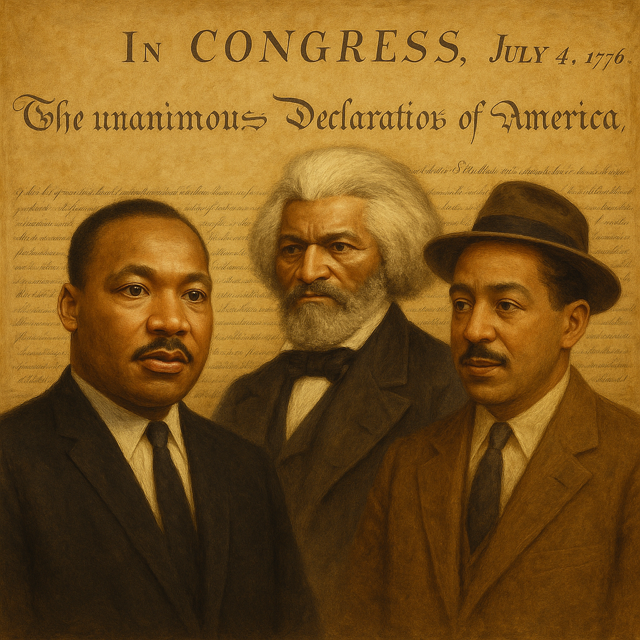
Regarding the picture, the backdrop is the Declaration of Independence and pictured from left to right are Rev. Martin Luther King Jr., Frederick Douglass, and Langston Hughes who once again are the moral “voices” for this essay.
In my previous essay. I referenced the Declaration of Independence as a “moral document” which provided enlightenment for the times then, 250-years ago, as well as for the times now. It expresses significant moral principles such as “all people are created equal endowed with unalienable rights like life, liberty, and the pursuit of happiness.” And that the government derives such powers from the “consent of the governed,” the focus of this essay. These principles are also presented as self-evident moral truths and asserted as universally binding on conscience and reason.
This is an especially timely topic given all that’s happening domestically within the Trump regime to stifle, resist, if not curtail completely the rights to dissent in the form of recent ‘No Kings’ and ‘Ice Out’ protests as well as the ongoing tragedies in Minneapolis. ‘We The People’ are demanding our rights and fulfilling our patriotic responsibilities to insist upon the “consent of the governed.”
At the international level, Trump reportedly told The New York Times recently that his “own morality” serves as the thing that could potentially limit his global powers — adding that he doesn’t “need international law. I’m not looking to hurt people,” Trump added. My comment: Tell that to the hundred or so Venezuelan fishermen he has killed without Congressional approval while alleging, without proof, that they were “narco-terrorists.
As another part of this wide-ranging interview with The Times, Trump was asked whether there were any limits to his global powers. “Yeah, there is one thing. My own morality. My own mind. It’s the only thing that can stop me,” Trump reportedly said.
In a cosmic-opposite contrast, the Founding Fathers and American revolutionary rhetoric were deeply shaped by biblical language and moral concepts that we should be abiding under per the Declaration and Constitution they authored two and a half centuries ago.
As author, professor and attorney Daniel Dreisbach suggests in his work ‘The Bible & the American Founders,’ our Founders were profoundly influenced by both the Old and New Testaments. And this carried over in their development of the Declaration and the Constitution. For more information about his associated research, please see the following video link:
Bottomline: Biblical moral language shaped moral thinking in the context that produced the Declaration and the Constitution. Trump’s claim of having guidance from his “own morality” stands feebly without merit, yet within his lifetime of atrocious and immoral actions.
Two final and repeated notes: there will be some repetition from previous essays, especially Essay #4, and I hope readers will see that more as reinforcement versus annoyance. Secondly, a continued shout out to my resource partner, CHAT GPT, for its contributions with each of these essays.
The Consent of the Governed: The Democratic Foundation of Legitimacy
I. Introduction: The Revolutionary Principle
Among the Declaration of Independence’s most transformative assertions is this:
“That to secure these rights, Governments are instituted among Men, deriving their just powers from the consent of the governed.”
This phrase struck at the very root of monarchy, aristocracy, and inherited privilege. It declared that political power was not a birthright of kings, nor a gift of God, but a trust granted by the people themselves.
In 1776, this was not simply a rejection of George III. It was a rejection of the idea that any government could claim legitimacy without popular consent.
It reframed the purpose of government: not to serve rulers or protect their status, but to secure rights for those who gave it authority.
But as with the Declaration’s other principles, “consent of the governed” was a promise betrayed in practice:
- Enslaved Africans were governed without any voice or consent
- Indigenous nations were dispossessed by treaties made without real representation
- Women were denied the vote and legal personhood
- The poor often lacked access to meaningful participation
The United States proclaimed consent while denying it to millions.
Yet this principle did not die. Instead, it became a moral standard used by the excluded to demand change.
Frederick Douglass, Martin Luther King Jr., and Langston Hughes each invoked it—exposing hypocrisy, demanding inclusion, and insisting that true consent requires justice.
II. Philosophical Foundations: Social Contract Theory
The Declaration’s phrase draws directly from Enlightenment social contract thinkers—particularly John Locke.
Locke argued that legitimate government arises only from the consent of those it governs.
In his Second Treatise of Government, he wrote:
“Men being, as has been said, by nature all free, equal, and independent, no one can be…subjected to the political power of another, without his own consent.”
For Locke, consent was not just a matter of formal agreement but an ongoing condition of legitimacy.
If rulers violated rights, they broke the social contract, freeing the people to establish new governance.
The Declaration transformed this into a revolutionary right. It said government exists to secure rights, and loses its legitimacy if it rules without consent.
This was a universal claim—but one profoundly limited by the Founders’ exclusions.
III. The American Revolution: Consent Against Empire
The Revolution itself was justified as a defense of consent.
The colonies protested taxation without representation, laws passed without colonial legislatures, governors imposed without local choice.
The Declaration listed these grievances as violations of the people’s right to self-government.
The idea was clear: government must rest on the will of the governed. If it rules without it, rebellion is justified.
This principle resonated globally. Anti-colonial movements from Haiti to India to Africa cited it to justify their own struggles for self-determination.
But even in 1776, the colonists’ demand for consent excluded enslaved Africans and Native nations whose own sovereignty was denied.
IV. The Founding Contradiction: Consent and Slavery
Perhaps the most glaring betrayal of this principle was the existence of slavery.
Enslaved people were governed by force alone. They could not vote, assemble freely, or resist legally.
Consent was entirely absent.
Yet slaveholders claimed to be champions of liberty. They justified their rule by denying the humanity of the enslaved, defining them as property rather than people with rights.
This contradiction was not accidental. It was a foundational compromise written into the Constitution.
The system depended on denying consent to maintain wealth and power for a ruling class.
V. Frederick Douglass: Exposing Hypocrisy, Demanding Inclusion
Frederick Douglass powerfully exposed this hypocrisy.
In his 1852 speech, “What to the Slave is the Fourth of July?”, he asked:
“Am I to argue that it is wrong to make men brutes, to rob them of their liberty, to work them without wages, to keep them ignorant of their relations to their fellow men? Must I undertake to prove that the slave is a man? That point is conceded already.”
Douglass showed that American government rested on the consent of the governed only for some.
He argued that slavery was incompatible with the very principles of the Declaration:
“Your fathers staked their lives, their fortunes, and their sacred honor, on the cause of their country. In their admiration of liberty, they lost sight of all other interests. They were peace men; but they preferred revolution to peaceful submission to bondage.”
Douglass claimed that enslaved people had a right to revolution because they were governed without consent.
He did not reject the Declaration. He called America to honor it.
VI. The Struggle for Emancipation: Consent Through Freedom
The abolition of slavery was more than a humanitarian reform. It was a recognition of the right of Black Americans to consent to their government.
Emancipation transformed millions from property to citizens.
But freedom alone was not enough. Without voting rights, education, and security, consent remained a fiction.
During Reconstruction, the 14th and 15th Amendments sought to guarantee Black citizenship and suffrage. For a brief period, Black men voted and held office across the South.
This was a radical experiment in multiracial democracy—a partial fulfillment of “consent of the governed.”
But white supremacist violence, disenfranchisement laws, and the withdrawal of federal protection destroyed Reconstruction.
Consent was once again denied through terror and fraud.
Douglass mourned this reversal but never surrendered the principle. He continued to demand the vote as the foundation of citizenship:
“Slavery is not abolished until the black man has the ballot.”
VII. The Betrayal of Reconstruction and the Rise of Jim Crow
The collapse of Reconstruction was not just a tragedy for Black rights—it was a fundamental violation of the principle of consent.
By the end of the 19th century, Black Americans in the South were systematically disenfranchised:
- Poll taxes
- Literacy tests
- Grandfather clauses
- White primaries
- Violence and terror, including lynching
Southern states claimed “home rule” and “states’ rights,” but their rule was based on excluding Black citizens from any say in government.
As Frederick Douglass recognized, this was not self-government but racial oligarchy.
In an 1889 speech, Douglass declared:
“We have had a war of emancipation, but we have not yet had a war of enfranchisement.”
He insisted that without the vote, Black people were “left without means of self-protection.”
Consent of the governed meant nothing if entire communities were excluded from the electorate.
VIII. Martin Luther King Jr.: The Vote as Consent
Almost a century later, Martin Luther King Jr. took up the same demand.
King understood that political participation was the bedrock of freedom.
In the Jim Crow South, Black citizens faced:
- Literacy tests designed to fail them
- Poll taxes they could not afford
- Registration purges and arbitrary obstacles
- Threats, beatings, and murders for trying to register or vote
King described this as a continuation of slavery by other means.
In 1965, leading the Selma-to-Montgomery marches, King called the right to vote “the foundation stone of political action.”
At the end of his “Give Us the Ballot” speech, he proclaimed:
“Give us the ballot, and we will no longer have to worry the federal government about our basic rights.”
King saw the vote as the practical expression of consent. Without it, there could be no accountability, no reform, no safety or happiness.
IX. The Voting Rights Act: Securing Consent
The Voting Rights Act of 1965 was a landmark achievement of the Civil Rights Movement.
It attacked the tools of disenfranchisement:
- Banning literacy tests
- Providing federal oversight in states with histories of discrimination
- Ensuring federal examiners could register voters when states refused
This law was a direct realization of the Declaration’s principle of consent of the governed.
King hailed its passage but warned that vigilance was required. He understood that racist power would adapt, seeking new ways to suppress the vote.
History proved him right.
X. Langston Hughes: Giving Voice to the Excluded
While King marched and Douglass thundered in speeches, Langston Hughes used poetry to amplify the silenced voices of the disenfranchised.
In “Let America Be America Again,” he wrote:
“I am the people, humble, hungry, mean—
Hungry yet today despite the dream.”
Hughes gave voice to workers, immigrants, sharecroppers, the unemployed—the people with no say in how they were governed.
He exposed the gap between the promise of democracy and the reality of exploitation.
“The free? Who said the free? Not me?
Surely not me? The millions on relief today?”
Hughes’s critique of America was not nihilistic. He insisted the dream was worth saving—but only by extending real power to those excluded from it.
Consent of the governed, for Hughes, demanded that all people be heard, not just the privileged few.
XI. Beyond the Ballot: Economic and Social Consent
Frederick Douglass, Martin Luther King Jr., and Langston Hughes all understood that consent was not limited to casting a vote every few years.
True consent requires the material conditions to exercise freedom meaningfully:
- Education
- Economic security
- Freedom from violence
- Equality before the law
Douglass argued that newly freed people needed land and education, not just formal freedom.
King, in his later years, called for a “radical redistribution of economic and political power.”
In his Where Do We Go From Here? speech (1967), he warned:
“We must recognize that we can’t solve our problem now until there is a radical redistribution of economic and political power.”
He launched the Poor People’s Campaign to demand jobs, income, and housing.
King understood that poverty undermined consent as surely as disenfranchisement.
XII. Structural Racism and Consent
King also condemned the structures that prevented Black people from shaping their own communities:
- Segregated housing policies
- Underfunded schools
- Discriminatory policing and courts
- Economic exploitation
He saw these not as accidental injustices but as systems designed to deny Black people effective power.
King argued that true consent of the governed required dismantling these systems.
As he put it:
“It didn’t cost the nation one penny to integrate lunch counters… but it will cost the nation billions to integrate schools and eradicate slums.”
He knew that those who benefited from racial hierarchy would not yield power voluntarily.
This was why organizing, protest, and political participation were essential.
XIII. Consent and the Right to Revolution
The Declaration does not simply say that governments should have consent—it says that if they lack it, people have the right to alter or abolish them.
This is the revolutionary core of the principle.
Douglass saw this clearly when he defended the right of enslaved people to rebel.
King adapted this idea to nonviolent civil disobedience.
He argued that when laws are unjust, people have not only the right but the duty to disobey them:
“One has a moral responsibility to disobey unjust laws.”
King’s nonviolence was not passivity. It was an organized refusal to consent to oppression.
It was, in effect, a form of revolutionary consent: withdrawing moral and political legitimacy from unjust systems, and building new forms of community rooted in justice.
XIV. The Right to Dissent: Preserving Consent
Consent of the governed is not a one-time event—it is an ongoing process.
It depends on the people’s ability to debate, dissent, and demand change.
Throughout American history, those in power have sought to suppress dissent in the name of “order”:
- The Sedition Acts of 1798 criminalized criticism of the government
- Abolitionists faced mobs, censorship, and imprisonment
- Labor organizers were beaten, jailed, and blacklisted
- Civil rights activists were spied on, harassed, and assassinated.
Frederick Douglass insisted on free speech as the “great moral renovator of society.”
He argued that without the right to protest, the governed lose all control over the government.
Martin Luther King Jr. understood this too. He wrote in Letter from Birmingham Jail:
“We know through painful experience that freedom is never voluntarily given by the oppressor; it must be demanded by the oppressed.”
King called unjust laws not merely illegitimate but deserving of open violation.
He understood that protecting dissent is how consent remains meaningful—not the consent of passive subjects, but of active citizens.
XV. Langston Hughes: Amplifying Silenced Voices
Langston Hughes’s poetry was itself a form of dissent.
He wrote not for the powerful but for the marginalized.
He gave voice to those denied the vote, denied justice, denied recognition.
In “Let America Be America Again,” he insisted that real democracy required hearing those voices:
“I am the farmer, bondsman to the soil.
I am the worker sold to the machine.
I am the Negro, servant to you all.
I am the people, humble, hungry, mean.”
Hughes’s demand was clear: America must live up to its promise by including those it had excluded.
Consent of the governed, for Hughes, meant recognizing all “the people,” not just the privileged.
XVI. Expanding the Franchise: An Ongoing Struggle
Even after the Civil Rights Movement’s victories, the struggle for consent of the governed continues.
Barriers to voting have evolved:
- Voter ID laws that disproportionately impact the poor and people of color
- Purges of voter rolls
- Gerrymandering that dilutes minority votes
- Closing polling places in marginalized communities
- Felon disenfranchisement that excludes millions
Martin Luther King Jr.’s warning remains relevant:
“So long as I do not firmly and irrevocably possess the right to vote I do not possess myself. I cannot make up my mind—it is made up for me.”
Consent of the governed requires constant vigilance to protect and expand access to the ballot.
XVII. Beyond Formal Democracy: Economic Power
Frederick Douglass, Martin Luther King Jr., and Langston Hughes all recognized that formal democracy was insufficient if economic power was monopolized by a few.
Consent requires the ability to shape not just government but the conditions of daily life.
King argued:
“Call it democracy, or call it democratic socialism, but there must be a better distribution of wealth within this country for all of God’s children.”
He saw poverty as a form of disenfranchisement.
Langston Hughes’s poetry exposed economic exploitation as antithetical to democracy:
“O, let America be America again—
The land that never has been yet—
And yet must be—the land where every man is free.”
Their visions connect political consent to economic justice.
XVIII. Collective Consent: Community, Not Just Individuals
The Declaration speaks of the consent of the governed—a collective, not merely individual, act.
Frederick Douglass understood that emancipation required collective action.
King envisioned the Beloved Community where people governed themselves together, with justice and love as guiding principles.
Langston Hughes dreamed of an America that belonged to all, not divided by class, race, or origin.
Consent is not simply a matter of isolated votes but of shared commitments.
It is built through organizing, solidarity, and mutual recognition.
XIX. The Moral Obligation to Renew Consent
The Declaration not only defines consent as the basis of legitimacy but insists that when government becomes destructive of rights, it is the duty of the people to alter or abolish it.
This is a profound moral responsibility.
Frederick Douglass insisted America could not call itself free while holding millions in bondage.
Martin Luther King Jr. demanded the nation transform itself to end segregation, poverty, and war.
Langston Hughes challenged America to finally become America for all.
Their work reminds us that consent is not static. It must be renewed in every generation.
It requires us to confront injustice, expand participation, and reimagine institutions.
XX. Conclusion: The Democratic Imperative
“That to secure these rights, Governments are instituted among Men, deriving their just powers from the consent of the governed.”
This sentence remains one of the most radical and challenging in the American tradition.
It says power is not inherited, bought, or seized—but given.
It demands that government remain answerable to those it governs.
Frederick Douglass used it to condemn slavery.
Martin Luther King Jr. used it to demand civil rights.
Langston Hughes used it to amplify the voices of the excluded.
Their legacy is clear:
Consent of the governed is not just permission to rule, but a mandate to serve.
It is not a passive state but an active relationship.
It is not a justification for the status quo but a moral standard by which all government must be judged.
When consent is betrayed through exclusion, oppression, or injustice, it must be reclaimed.
And so the work continues:
- Expanding the franchise
- Protecting dissent
- Challenging inequality
- Building communities of solidarity
This is the unfinished revolution of democracy.
This is the meaning of consent of the governed!

February 6, 2026 11:43 pm /
[…] https://www.wewynneauthor.com/2026/01/30/declaration-of-independence-essay-7-consent-of-the-governed […]
February 14, 2026 12:22 am /
[…] https://www.wewynneauthor.com/2026/01/30/declaration-of-independence-essay-7-consent-of-the-governed […]