
Declaration of Independence… Essay #8: “To Alter or Abolish”
At the beginning of the eighth essay in my series on ‘The American Creed’ (see below), it state:“Government is not sacred in and of itself. It is a tool. Its sole purpose is to secure rights. When it fails in that purpose, people are not merely permitted but entitled to change it. This is a moral claim, not merely a political convenience. It places the governed at the center of political legitimacy, making them both the source of power and the ultimate check on abuse.”
While concluding a recent presentation about the ‘American Creed’ at Webster Library, I emphasized the moral demand and covenant of the Declaration of Independence. A good friend approached me afterwards and cautioned me that the moral high road could be a slippery conversational slope. The rationale was based on his personal experience regarding discussions with others unaligned with his views and their opposite interpretations of morality vis-à-vis events of the day. This unfortunately is not that uncommon in my experience as well
However, my take on his thinking can be summarized as follows:
- Putting on the mantel of the American Creed as a moral promise “to secure rights” I believe can lead to more promising conversations than taking a strictly political or legal posture.
- The “events of the day” routinely and tragically reveal that shooting peaceful protestors, putting little children in handcuffs, forcibly entering homes without a warrant, intentional and perverse failures regarding “due process”, and on and on signal that our federal law enforcement has lost its way, if not its soul vis-à-vis the Declaration.
- Our legacy as a country and to our children and grandchildren is jeopardized, if not unravelling, since our democracy is being shredded by these actions.
- The spirit of “Imago Dei” in Genesis 1:26-27 reminds us that we are ALL made in the “Image and Likeness of God” within His infinite love. What better starting point to frame a conversation is there than that?
- This could then open-up a path to introduce the beauty of the Gospel’s Eight Beatitudes, and the Good Samaritan into the conversation and provide some very helpful insights into spiritual, personal, and political thinking among all sides.
- This would perhaps open-up insights regarding the power of community, connection, and love to others, such as the importance of community ties and shared stories in shaping individual identities and collective memory.
- Bottomline: the moral high road premised on love might be a slippery slope, but I believe lends itself to more powerful discussion paths compared to mere political or legal starting points.
And while reading the following essay, please take note that its “revolutionary” rhetoric is enlightening this perhaps risky and arduous path as a moral responsibility.
Two final and repeated notes: there will be some repetition from previous essays and this one especially amplifies the discussion in Essay #5. I hope readers will continue to see that more as reinforcement versus annoyance. Secondly, a continued shout out to my resource partner, CHAT GPT, for its contributions with each of these essays.
I. Introduction: The Right of Revolution
Among the most radical and consequential declarations in the American tradition is this:
“That whenever any Form of Government becomes destructive of these ends, it is the Right of the People to alter or to abolish it, and to institute new Government.”
With these words, the Declaration of Independence did not simply justify rebellion against King George III. It enshrined the principle that the legitimacy of government is conditional.
Government is not sacred in and of itself. It is a tool. Its sole purpose is to secure rights. When it fails in that purpose, people are not merely permitted, but entitled to change it.
This is a moral claim, not merely a political convenience. It places the governed at the center of political legitimacy, making them both the source of power and the ultimate check on abuse.
It is also a promise that has repeatedly been betrayed.
Throughout American history, powerholders have sought to deny this right to those they govern:
- Enslaved people forced to submit to masters
- Indigenous nations dispossessed of their sovereignty
- Women denied the vote or legal agency
- Workers crushed when they organized
- Black citizens terrorized to prevent political participation
The right to “alter or abolish” was celebrated in 1776 but suppressed when others invoked it.
Yet it never disappeared. It became the rallying cry of abolitionists, civil rights activists, labor organizers, and freedom movements around the world.
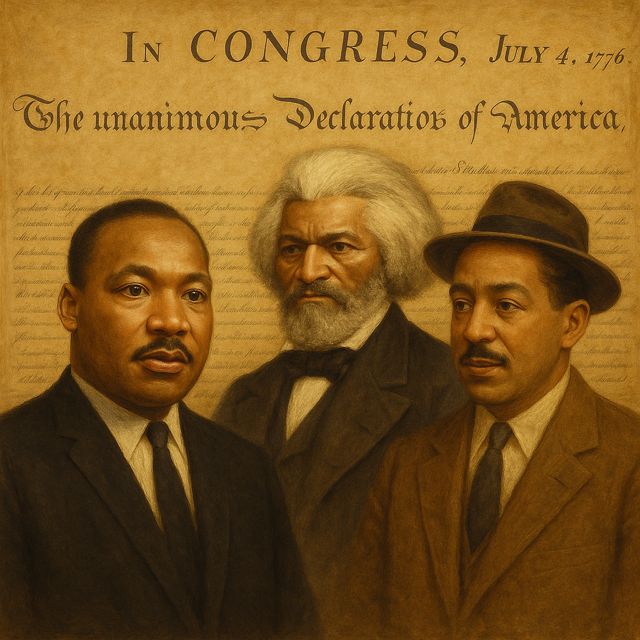
Frederick Douglass, Martin Luther King Jr., and Langston Hughes each engaged with this principle—revealing its power, its hypocrisy, and its enduring necessity.
II. The Philosophical Foundations: Conditional Legitimacy
The Declaration’s assertion echoes the Enlightenment period’s social contract theory.
John Locke argued that government exists by the consent of the governed. But this was not blind or permanent consent.
In his Second Treatise of Government, Locke wrote:
“Whenever the legislators endeavor to take away and destroy the property of the people, or to reduce them to slavery under arbitrary power, they put themselves into a state of war with the people…who are thereupon absolved from any further obedience.”
For Locke, the people’s right to resist or overthrow their rulers was not chaos but self-defense against tyranny.
The Declaration adapted this logic, making it an explicit moral foundation of American government.
But even as the Founders invoked this principle, they limited its application. They refused to see that their own systems—enslavement, exclusion of women, genocide of Native nations—violated the rights they claimed to defend.
III. The American Revolution as Precedent
In 1776, American colonists used this principle to justify breaking from Britain.
They argued that Parliament and the Crown had violated their rights:
- Taxation without representation
- Standing armies imposed on them
- Trade restrictions that strangled economic freedom
- Denial of local self-government
The Declaration lists these grievances to show that revolution was not rash but necessary.
It presents revolution as the people’s duty when government becomes destructive of rights.
This set a precedent that would echo across history.
But it also contained a deep hypocrisy: the colonists demanded freedom for themselves while denying it to others.
IV. The Enslaved and the Denial of the Right to Revolt
Nowhere was the hypocrisy clearer than in slavery.
Enslaved Africans were denied all rights, forced to submit to absolute, violent control.
Their masters demanded loyalty and obedience while praising their own revolution.
Slave revolts—like Gabriel’s Rebellion, Denmark Vesey’s conspiracy, Nat Turner’s uprising—were treated as monstrous crimes, crushed with brutal force.
Frederick Douglass pointed out this hypocrisy relentlessly.
In his 1852 speech, he said:
“You profess to believe that, of one blood God made all nations of men to dwell on the face of all the earth. You declare, before the world, and are understood by the world to declare, that you ‘hold these truths to be self-evident, that all men are created equal’…and yet you hold securely, in a bondage which, according to your own Thomas Jefferson, is worse than ages of that which your fathers rose in rebellion to oppose, a seventh part of the inhabitants of your country.”
Douglass claimed the right to revolution for the enslaved as a matter of justice and consistency.
V. Frederick Douglass and the Moral Right to Resistance
Douglass understood that the right to “alter or abolish” was meaningless if reserved for the powerful.
He saw it as the birthright of the oppressed.
In his writings and speeches, he defended slave resistance not as criminal but as a moral necessity.
He praised those who fled slavery. He condemned the Fugitive Slave Act as an attempt to deny the natural right to liberty.
For Douglass, the enslaved had every right to resist, to rebel, to escape—to abolish the system that denied their humanity.
This was not mere rhetoric. It was a profound claim:
If government exists to secure rights, then any government that enshrines slavery forfeits all legitimacy.
Douglass demanded that America either live up to its own revolutionary ideals or be condemned by them.
VI. Abolition as Revolution
The abolitionist movement itself was an effort to “alter or abolish” an unjust system.
It sought not only to end the legal status of slavery but to remake American society.
Abolitionists challenged laws, public opinion, economic interests, and political institutions.
They used moral persuasion, political organizing, civil disobedience, and direct aid to fugitives.
They faced violence, arrest, and social ostracism.
Yet they insisted that the nation’s legitimacy depended on ending slavery.
Douglass argued that abolition was the fulfillment of the Declaration’s promise:
“I want a country that will be in fact what it is in spirit.”
He saw the Civil War itself as the nation’s reckoning—a violent but necessary revolution to abolish a system incompatible with freedom.
VII. Reconstruction: A Revolutionary Moment
After the Civil War, America faced the question: would it truly alter its institutions to secure rights for all?
Reconstruction was, in many ways, a radical experiment in fulfilling the Declaration’s promise.
The 13th Amendment abolished slavery.
The 14th Amendment guaranteed equal protection.
The 15th Amendment sought to secure voting rights regardless of race.
For the first time, Black men held political office in the South. Public schools expanded. Laws were rewritten.
This was America attempting to alter itself in pursuit of its stated ends.
Frederick Douglass celebrated these changes while warning that the work was unfinished.
He knew that simply abolishing slavery was not enough if Black Americans remained vulnerable to violence, poverty, and disenfranchisement:
“Slavery is not abolished until the black man has the ballot.”
But white supremacist backlash crushed Reconstruction.
Through terror, disenfranchisement, and Jim Crow laws, the South “abolished” Black rights instead of racist power structures.
The revolutionary promise was betrayed.
VIII. Martin Luther King Jr.: A Modern Revolutionary Demand
Nearly a century after Douglass, Martin Luther King Jr. took up the same demand for fundamental change.
King invoked the Declaration’s revolutionary principle explicitly.
In Letter from Birmingham Jail, he wrote:
“One has not only a legal but a moral responsibility to obey just laws. Conversely, one has a moral responsibility to disobey unjust laws.”
He argued that segregation laws were unjust because they degraded human personality and violated moral law.
Civil disobedience was not lawlessness—it was an effort to alter an unjust system by exposing its immorality and forcing reform.
King insisted that America could not claim legitimacy while denying rights to millions of its citizens.
IX. The Civil Rights Movement as Peaceful Revolution
King’s philosophy of nonviolent direct action was revolutionary in purpose, if not in method.
He described it as creating “constructive tension” to force negotiation and change.
This was not gradual accommodation but deliberate confrontation with unjust power.
The Civil Rights Movement altered American institutions:
- Ending legalized segregation
- Securing the Civil Rights Act of 1964
- Winning the Voting Rights Act of 1965
Yet King recognized these victories as partial.
In his later speeches, he demanded a deeper revolution:
“We are called upon to help the discouraged beggars in life’s marketplace. But one day we must come to see that an edifice which produces beggars needs restructuring.”
For King, to “alter or abolish” meant challenging not only racial injustice but economic exploitation and militarism.
X. The Poor People’s Campaign: Expanding the Revolutionary Vision
In 1968, King launched the Poor People’s Campaign—an effort to unite poor Black, white, Latino, and Indigenous people in demanding economic justice.
He called for:
- Guaranteed jobs or income.
- Living wages
- Decent housing
- Quality education
King argued that the existing economic system itself was destructive of human rights and dignity.
“America is the richest nation in the world, and yet she has millions of poor people. What is America doing about this?”
He called for a radical restructuring of society—a peaceful but profound abolition of poverty itself.
This demand built on the Declaration’s principle:
If existing forms of government and economy destroy rights, they must be altered or abolished.
XI. The Right—and Duty—to Resist Unjust Power
King’s insistence on nonviolence did not mean submission to injustice.
He condemned “negative peace,” which was merely the absence of tension without the presence of justice.
He believed civil disobedience was necessary when legal channels protected oppression.
“Freedom is never voluntarily given by the oppressor; it must be demanded by the oppressed.”
This was an expression of the Declaration’s revolutionary logic:
- When laws are unjust, people have the right to break them
- When institutions entrench injustice, people have the duty to transform them
King framed this not as chaos, but as moral order—restoring government to its true purpose of securing rights.
XII. Langston Hughes: The Call to Remake America
While Douglass and King gave speeches, Langston Hughes used poetry to amplify the same revolutionary principle.
In “Let America Be America Again,” Hughes laments:
“America never was America to me.”
But he does not reject America outright. He calls for its remaking:
“O, yes,
I say it plain,
America never was America to me,
And yet I swear this oath—
America will be!”
Hughes’s vision is revolutionary. It is a promise to alter the nation until it becomes what it claims to be.
He gives voice to all who have been excluded:
- The poor white
- The Black worker
- The immigrant
- The Indigenous person
For Hughes, the demand to “alter or abolish” is the demand to create an America that belongs to all its people.
XIII. Structural Violence and the Need for Change
King and Hughes both recognized that injustice is not always a matter of overt violence.
Structural violence—poverty, segregation, discrimination, neglect—destroys lives just as surely.
King warned:
“A nation that continues year after year to spend more money on military defense than on programs of social uplift is approaching spiritual death.”
He saw that reform was not enough if structures remained intact that perpetuated inequality.
To secure rights truly, it was necessary to alter these structures:
- Redistributing resources
- Democratizing power
- Centering human dignity
This was not a call to overthrow society into chaos but to reorganize it on new, just foundations.
XIV. The Challenge of Reaction and Suppression
Throughout American history, efforts to alter unjust systems have been met with fierce resistance.
After Reconstruction, white supremacists used terror, disenfranchisement, and Jim Crow laws to restore racial hierarchy.
During the labor struggles of the late 19th and early 20th centuries, workers who organized to change working conditions faced:
- Police repression
- Company thugs
- Anti-union laws
- Blacklists and firing
The civil rights movement faced:
- Arrests
- Beatings
- Bombings
- Assassinations of its leaders
Martin Luther King Jr. was harassed by the FBI, denounced as an extremist, and ultimately murdered.
These reactions reveal a fundamental truth about the Declaration’s principle:
The right to alter or abolish government is not granted by those in power. It must be claimed by those oppressed.
XV. The Moral Duty to Confront Injustice
The Declaration does not frame revolution as mere permission. It says:
“…it is their right, it is their duty, to throw off such Government, and to provide new Guards for their future security.”
This is a moral obligation.
Frederick Douglass argued that citizens had a duty to oppose slavery.
He condemned Northern apathy and complicity with the Fugitive Slave Act.
He urged action—through speech, organizing, and, when necessary, aiding escape and resistance.
Martin Luther King Jr. argued similarly about segregation and poverty.
He said those who remained silent in the face of injustice were complicit:
“He who passively accepts evil is as much involved in it as he who helps to perpetrate it.”
King demanded not simply legal reform but moral awakening.
XVI. Nonviolent Revolution: King’s Vision
King offered a distinct vision of what it meant to “alter or abolish” unjust government.
He rejected violent overthrow, not because the status quo was legitimate, but because he believed nonviolence was a more effective and ethical method of revolution.
Nonviolent action aimed to:
- Expose injustice
- Mobilize public conscience
- Build solidarity among the oppressed
- Force negotiations and change
King’s marches, sit-ins, boycotts, and mass meetings were designed to shake the foundations of segregation and racism without resorting to killing or terror.
He saw this as the highest expression of the Declaration’s revolutionary promise:
“We must meet physical force with soul force.”
XVII. Langston Hughes: The Revolutionary Imagination
Langston Hughes understood that altering unjust systems also requires transforming the American imagination.
He wrote about the dreams of the excluded:
“I am the one who dreamt our basic dream
In the Old World while still a serf of kings,
Who dreamt a dream so strong, so brave, so true,
That even yet its mighty daring sings.”
Hughes did not call for violent overthrow but for a revolution of inclusion.
He demanded that America reckon with its broken promises and remake itself to serve all its people.
He refused to let the nation off the hook with empty slogans about freedom.
His poetry is a call to abolish hypocrisy and alter the structures that breed inequality.
XVIII. The Right to Alter or Abolish Today
The Declaration’s principle is not frozen in 1776. It remains relevant wherever government becomes destructive of rights.
Modern struggles for justice embody this right:
- The movement for voting rights to combat disenfranchisement
- Labor movements seeking fair wages and safe conditions
- Environmental justice activists demanding an end to destructive policies
- Movements for racial justice challenging police violence and mass incarceration
- LGBTQ+ activists seeking legal and social equality
These are not acts of disloyalty but exercises of the right—and duty—to transform unjust systems.
They aim to alter laws, policies, and institutions so they secure rights for all.
XIX. Limits and Responsibilities of the Right
The Declaration also warns against “light and transient causes” for revolution.
It recognizes the gravity of dismantling governments and the chaos that can result.
Frederick Douglass understood this. While he defended the right to resist slavery, he warned against rash violence.
King was even more explicit, insisting that revolution must be guided by love and justice, not vengeance or hate.
He wrote:
“Hate cannot drive out hate; only love can do that.”
The right to alter or abolish government is not a license for nihilism or tyranny.
It is a responsibility to build better—to create new structures that truly secure safety and happiness for all.
XX. Conclusion: The Unfinished Revolution
“Whenever any Form of Government becomes destructive of these ends, it is the Right of the People to alter or to abolish it, and to institute new Government.”
This principle remains one of America’s most radical promises.
It is the idea that no system is sacred if it denies human rights.
That legitimacy rests on serving the governed.
That power must always be answerable to the people.
Frederick Douglass used it to condemn slavery and demand abolition.
Martin Luther King Jr. used it to challenge segregation, poverty, and war.
Langston Hughes used it to call for an America that fulfilled its dream.
Their work reminds us:
The revolution is not a moment in the past. It is an ongoing responsibility.
To alter what oppresses.
To abolish what dehumanizes.
To build what liberates.
This is not a betrayal of the American promise. It is its truest fulfillment.
The Declaration’s words remain a call—to critique, to resist, to imagine, and to act.
Until freedom, equality, safety, and happiness are secured for all, the right—and the duty—to alter or abolish unjust systems remains.
This is the unfinished work of democracy.
